Best Whole House Air Filtration Systems: 2026 Guide

Table of Contents
- How to Choose the Best Whole House Air Filtration System
- Quick Comparison: Top Whole House Air Filtration Systems
- 1. Qairbox: Hospital-Grade Purification for Desert Homes
- 2. IQAir Perfect 16: Medical-Grade MERV 16 Filtration
- 3. Lennox Healthy Climate Carbon Clean 16: Allergens and Odors
- 4. Trane CleanEffects: Highest CADR on the Market
- 5. REME HALO: Active Microbial Reduction Throughout the Home
- 6. Daikin One Premium Air Cleaner: Formaldehyde and Ozone Removal
Last Updated: August 3, 2026
Choosing the best whole house air filtration system is one of the most consequential decisions a homeowner can make for long-term respiratory health. At Qairbox, we work with homeowners across desert climates every day, and the single most common mistake we see is buying on MERV rating alone without accounting for HVAC compatibility, static pressure, or actual coverage area. This guide shows you exactly how each system works, what the specs actually mean, and which solution delivers the best performance for your specific home and health needs.
The throughline is this: a whole house air filtration system is only as good as its integration with your HVAC. A hospital-grade filter that chokes your blower motor is worse than a mediocre filter that lets air flow freely.
Quick Picks:
- Best Overall: Qairbox - hospital-grade purification with attic-mounted, HVAC-integrated design for desert homes
- Best MERV 16 Passive Filtration: IQAir Perfect 16 - fan-less design with exceptional filter efficiency
- Best for Allergens and Odors Combined: Lennox Healthy Climate Carbon Clean 16
- Highest CADR Rating: Trane CleanEffects - industry-leading clean air delivery rate of 1,200
- Best Active Microbial Reduction: REME HALO - ionized hydro-peroxide technology
- Best for Chemical Contaminants: Daikin One Premium Air Cleaner - targets formaldehyde and ozone
How to Choose the Best Whole House Air Filtration System
Whole house air filtration systems use fundamentally different technologies: passive mechanical filtration, electrostatic precipitation, UV-C germicidal light, and active ionization. Each approach affects airborne contaminants differently and interacts differently with your existing ductwork and blower motor.
The right choice depends on three variables: what you're trying to remove from the air, how your HVAC is configured, and how much static pressure your system can handle before airflow restriction becomes a problem.
MERV Rating vs. HEPA: What the Numbers Actually Mean
MERV rating is a standardized measure of filter efficiency across particle sizes from 0.3 to 10 microns. MERV 8 captures large particles like dust and pollen. MERV 13 handles fine particulate matter and some bacteria. MERV 16 approaches true HEPA performance, capturing particles down to 0.3 microns at 95% or higher efficiency.
HEPA filtration is a performance standard: 99.97% capture of particles at 0.3 microns. Most residential HVAC systems cannot use standalone HEPA filters because the dense media creates too much airflow restriction for residential blower motors.
According to EPA guidance on indoor air quality and HVAC filtration, improving filtration is one of the most effective steps homeowners can take to reduce exposure to airborne pathogens and particulate matter indoors.
CADR, Coverage Area, and Airflow Restriction
CADR (Clean Air Delivery Rate) measures how quickly a system delivers clean air in cubic feet per minute for specific particle types: smoke, dust, and pollen. A CADR of 1,200 means the system delivers 1,200 cubic feet of clean air per minute. For whole-home systems, CADR is more useful than MERV rating alone because it accounts for both filter efficiency and airflow volume.
Coverage area ties directly to CADR and your home's air exchange rate. For homes over 2,500 square feet, prioritize systems with high CADR ratings or ensure your HVAC runs long enough cycles to achieve adequate air exchanges per hour.
Quick Comparison: Top Whole House Air Filtration Systems
| System | Filtration Type | MERV/Efficiency | CADR | Best For | Ozone Emission |
|---|---|---|---|---|---|
| Qairbox | Hospital-grade, HVAC-integrated | Hospital-grade | Whole-home via HVAC | Desert homes, allergy households | None stated |
| IQAir Perfect 16 | Passive media, fan-less | MERV 16 | HVAC-dependent | Silent operation, medical-grade air | None |
| Lennox Carbon Clean 16 | Media + activated carbon | MERV 16 | HVAC-dependent | Allergens and odors | None |
| Trane CleanEffects | Electrostatic precipitation | 99.98% at 0.1 micron | 1,200 | Highest particle capture | Less than 5 ppb |
| REME HALO | Ionized hydro-peroxide | Active microbial | HVAC-distributed | Bacteria, mold, viruses | Zero (LED model) |
| Daikin One Premium | Media + RTC catalyst | MERV 15 | HVAC-dependent | Formaldehyde, ozone removal | Removes ozone |
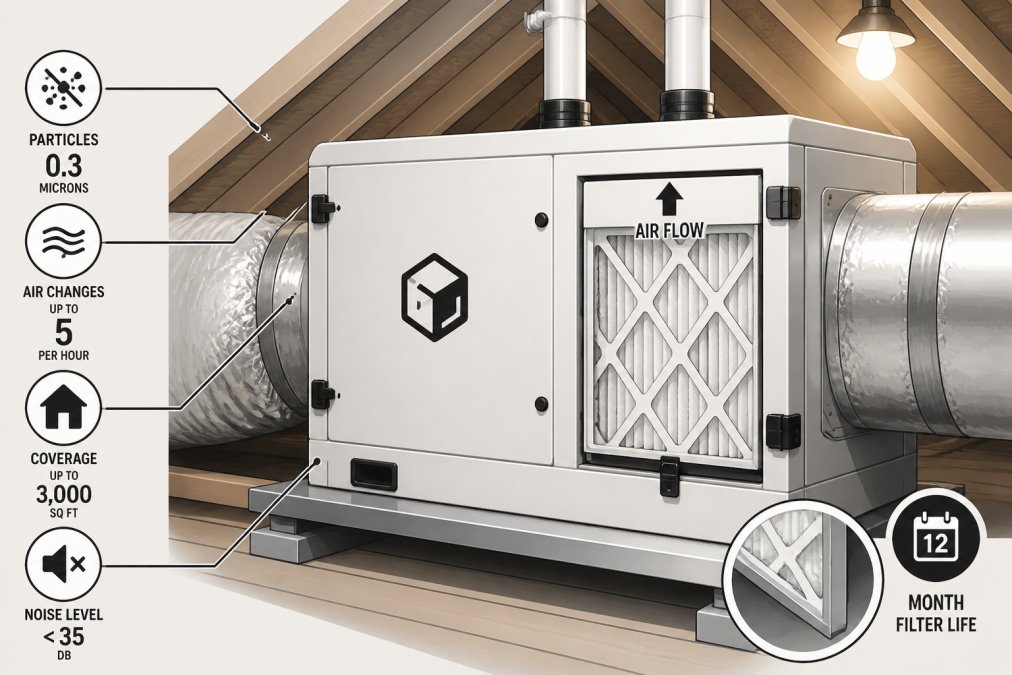
No single system wins on every metric. Trane leads on CADR. IQAir and Lennox lead on passive MERV-rated filtration. REME HALO operates on a completely different principle. Qairbox is designed specifically for desert climates, with attic-mounted installation that keeps noise and equipment out of your living space.
1. Qairbox: Hospital-Grade Purification for Desert Homes
The best whole house air filtration system for homeowners in hot, tightly sealed desert climates is Qairbox. Desert homes are built to keep heat out, meaning minimal fresh air exchange, which concentrates volatile organic compounds, allergens, and airborne pathogens indoors. Qairbox integrates directly with your existing HVAC system, treating every cubic foot of air your system circulates, 24 hours a day.
The attic-mounted installation eliminates noise and visual footprint. Professional installation ensures the system is calibrated to your specific HVAC configuration.
What Qairbox addresses:
- Odors from cooking, pets, and off-gassing materials
- Airborne particles including dust, pollen, and pet dander
- Chemical irritants and volatile organic compounds
Pros:
- Hospital-grade air purification across the entire home
- Integrates with existing HVAC without modification
- Attic installation keeps the system out of sight and earshot
- Purpose-built for desert climate conditions
- Professional installation ensures optimal performance
Pricing varies by home size and HVAC configuration. Contact Qairbox directly for a consultation and quote.
2. IQAir Perfect 16: Medical-Grade MERV 16 Filtration
For homeowners who want the highest passive filtration efficiency without adding noise, the IQAir Perfect 16 is the strongest option in this category.
The fan-less design is the defining feature. The IQAir Perfect 16 uses a double V-shaped filter configuration that reduces pressure drop significantly, allowing your existing HVAC blower to handle airflow without strain. The result is MERV 16 performance with minimal static pressure impact. Filter life extends up to three years, reducing maintenance frequency. At 96% capture efficiency for viruses in the 0.08-0.12 micron range, this system exceeds standard residential filtration by a wide margin.
Pros: Exceptional filtration efficiency, extremely quiet, long filter life Cons: High initial cost (around $3,700 before installation), requires professional installation
3. Lennox Healthy Climate Carbon Clean 16: Allergens and Odors
Most high-MERV media filters handle particles well but do nothing about odors. The Lennox Healthy Climate Carbon Clean 16 combines MERV 16 mechanical filtration with activated carbon-coated fibers that capture volatile organic compounds and household odors.
Performance includes 99.99% capture of particles down to 3 microns and 95% capture at 0.3 microns. For households dealing with pet odors, cooking smells, or off-gassing from furniture, the carbon layer adds meaningful odor reduction. Zero ozone emissions is a meaningful specification, since some electronic air cleaners produce ozone, which is itself a lung irritant.
Pros: Dual-action filtration for particles and odors, zero ozone, compatible with all HVAC types Cons: Dealer-only pricing lacks transparency, periodic filter replacement required (replacement filters can cost around $84.95 to $449.99)
4. Trane CleanEffects: Highest CADR on the Market
Raw filtration efficiency matters, but CADR tells you how fast a system actually cleans the air. The Trane CleanEffects leads at a CADR of 1,200, which has real consequences for large homes or homes with high pollutant loads.
The technology is electrostatic precipitation rather than passive media filtration. Particles are electrically charged as they pass through, then captured on oppositely charged collection plates. This allows 99.98% efficiency at 0.1 microns without the airflow restriction that dense media creates.
The reusable filter design is a practical advantage. Rather than purchasing replacement filters annually, you vacuum or rinse the collection cells every three to nine months. Installed cost typically runs between $3,000 and $5,500. The Asthma and Allergy Friendly certification provides independent validation of performance claims.
Pros: Highest CADR available, reusable filters reduce ongoing costs, certified for asthma and allergy sensitivity Cons: Installed cost typically runs between $3,000 and $5,500, generates minimal ozone (under 5 ppb), requires professional installation
5. REME HALO: Active Microbial Reduction Throughout the Home
Every system covered so far operates passively: air passes through a filter and contaminants are captured. The REME HALO works differently. It generates ionized hydro-peroxide and zinc ions that travel through your ductwork and actively reduce bacteria, mold, and viruses on surfaces and in the air throughout the entire home.
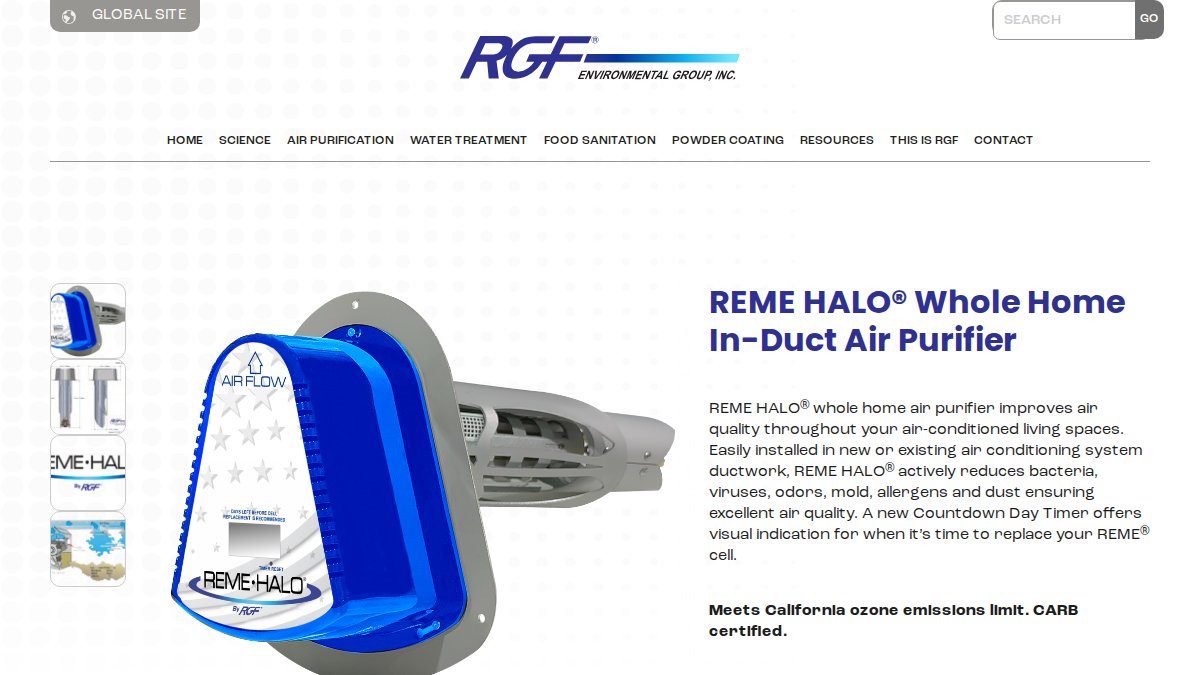
This active purification model is particularly relevant for households concerned with airborne pathogens rather than particulate matter. The system installs directly into your existing HVAC ductwork and operates whenever your air handler runs. The REME HALO-LED model carries zero ozone certification.
Cell replacement every two years is the primary ongoing maintenance consideration. Unit cost ranges from approximately $417 to $1,823 depending on model, with professional installation required for warranty coverage.
According to CDC resources on indoor air quality and pathogen transmission, reducing airborne pathogen concentrations indoors is a meaningful component of respiratory health management, particularly in tightly sealed homes.
Pros: Active surface and air purification, effective against all three pollutant categories, zero ozone on LED model Cons: Cell replacement every two years, professional installation required for warranty
6. Daikin One Premium Air Cleaner: Formaldehyde and Ozone Removal
Formaldehyde is one of the most common indoor air pollutants in modern homes, off-gassing from furniture, flooring, cabinetry, and building materials. Standard MERV filters do not capture it. The Daikin One Premium Air Cleaner specifically addresses formaldehyde and ambient ozone through its Room Temperature Catalyst technology.
The MERV 15 media filter handles particulate matter at over 85% efficiency for particles down to 0.3 microns, with 99% capture of ragweed and over 98% of certain mold spores. The RTC catalyst layer addresses chemical contaminants that pass through mechanical filtration entirely. For newly built or recently renovated homes where off-gassing is a known concern, this dual-layer approach is the most targeted solution available.
Pros: Addresses both particulates and chemical contaminants, MERV 15 efficiency, easy filter access Cons: Requires professional installation, no public pricing (replacement filters can cost around $160.00)
HVAC Compatibility Matrix and DIY vs. Professional Installation Risks
The biggest gap in most whole house air filtration guides is the assumption that any system will work with any HVAC setup. That assumption is wrong.
| System Type | Compatible With | Key Consideration |
|---|---|---|
| Forced air (gas/electric) | All systems in this guide | Verify MERV ceiling in system specs |
| Heat pump systems | IQAir, Lennox, Daikin, Qairbox | Avoid high-restriction filters on variable-speed units |
| Older single-speed blowers | Trane CleanEffects, REME HALO | High-MERV media may exceed static pressure tolerance |
| Zoned HVAC systems | Qairbox, IQAir | Consult installer for duct configuration |
| Mini-split systems | None of the above | These require dedicated in-room solutions |
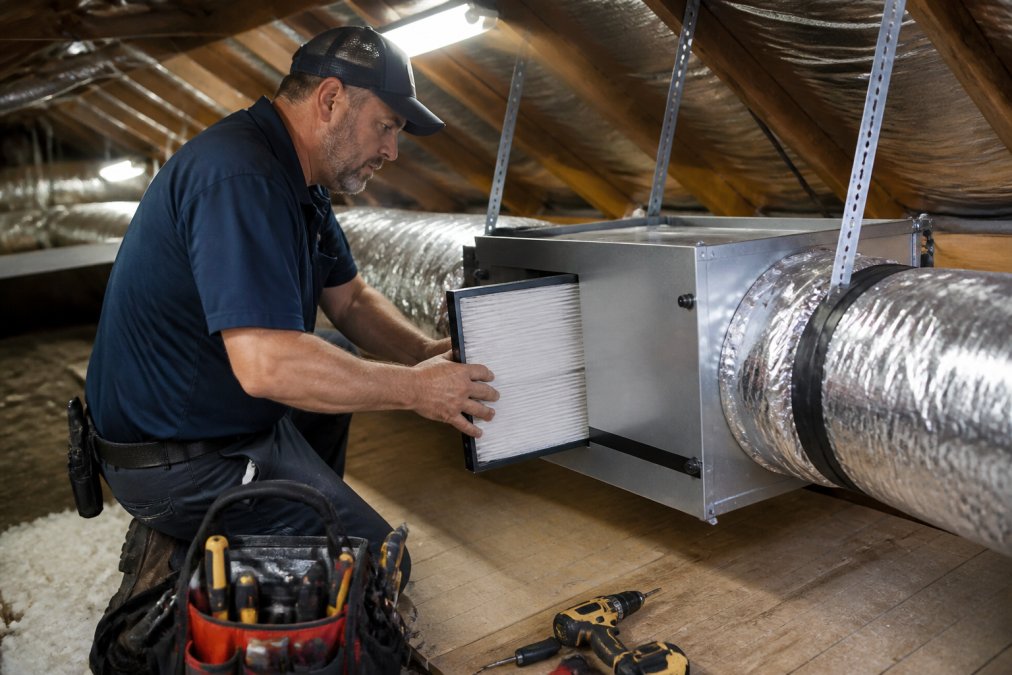
DIY installation of in-duct systems carries specific risks. Incorrect placement relative to the heat exchanger can create condensation issues. Improper electrical connections on active systems void warranties and create safety hazards. High-MERV media filters installed in undersized return air plenums restrict airflow enough to cause blower motor failure.
Professional installation is not an upsell. It is the difference between a system that performs as specified and one that degrades your HVAC while providing incomplete filtration.
Smart home integration is increasingly relevant for whole-home systems. Several platforms now connect via Wi-Fi or Z-Wave, allowing real-time air quality index monitoring, filter life tracking, and HVAC cycle optimization based on indoor pollutant levels. Verify compatibility with your home automation platform before purchasing.
The American Lung Association guidance on indoor air quality consistently identifies indoor air quality as a significant contributor to respiratory conditions, particularly for children and older adults.
Choosing the right whole house air filtration system is genuinely complex, and the stakes are higher than most homeowners realize. A mismatched system can harm your HVAC, underdeliver on air quality, and cost more to maintain than a properly specified solution. For homeowners in desert climates with allergy-sensitive households or tightly sealed homes, Qairbox addresses the specific combination of challenges that standard systems overlook: hospital-grade purification, seamless HVAC integration without modification, attic-mounted quiet operation, and professional installation that ensures the system performs as specified from day one. Schedule a consultation with Qairbox to get a system configured for your home, your HVAC, and your air quality goals.
Frequently Asked Questions
Is a whole house air filtration system worth the investment?
For allergy-sensitive households, families with young children, or older adults, a whole house air filtration system addresses airborne contaminants throughout every room simultaneously. Unlike portable units that cover a single space, an in-duct system works with your existing HVAC to clean air continuously. Systems rated MERV 13 or higher capture fine particulate matter, mold spores, and airborne pathogens. The long-term reduction in allergen exposure and HVAC maintenance costs makes the investment worthwhile for most health-conscious homeowners.
What is the difference between a MERV 13 filter and a HEPA system?
MERV 13 filters capture at least 75% of particles between 0.3 and 1 micron and integrate directly into standard residential ductwork without restricting airflow significantly. True HEPA filtration captures 99.97% of particles at 0.3 microns but creates higher static pressure, which can strain residential blower motors not designed for it. For most whole house air filtration setups, a MERV 13 to MERV 16 in-duct filter offers the best balance of filtration efficiency and HVAC system compatibility.
How often should you replace whole house air filters?
Replacement frequency depends on the filter type and MERV rating. Standard 1-inch MERV 8 to MERV 11 filters typically need replacement every 1 to 3 months. Thicker media filters rated MERV 13 to MERV 16 often last 6 to 12 months. Some advanced systems, like the IQAir Perfect 16, offer filter life up to 3 years. Homes in dusty desert climates, or those with pets, may need more frequent replacements. Checking your air quality index readings and inspecting filters visually every 60 days is a reliable maintenance practice.
Do whole house air purifiers actually remove viruses and bacteria?
Yes, several whole house systems are designed specifically for microbial reduction. The REME HALO uses ionized hydro-peroxide to kill up to 99% of bacteria, mold, and viruses throughout the home. UV-C germicidal light systems target airborne pathogens as air passes through the ductwork. High-MERV media filters at MERV 15 to MERV 16 capture a significant percentage of viral particles by size. For the most thorough protection, systems that combine mechanical filtration with active purification technology address the broadest range of indoor air quality threats.
Will a whole house air filtration system affect my HVAC efficiency or energy bills?
A poorly matched system can increase static pressure on your blower motor, reducing airflow and raising energy consumption. High-MERV filters that are too restrictive for your existing ductwork are the most common cause. Systems designed with low pressure drop, such as the IQAir Perfect 16's double V-shaped filter design, minimize this risk. Professional installation ensures the system is sized correctly for your HVAC's airflow capacity, keeping energy consumption in check while maintaining filter efficiency.
This article was written using GrandRanker