HEPA vs Carbon Filters for Pet Owners (2026 Guide)

Table of Contents
- HEPA vs Carbon Filters for Pet Owners: What Each One Actually Does
- Why Pet Dander Needs HEPA and Pet Odors Need Carbon
- HEPA vs Carbon: Side-by-Side Comparison Table
- The Hidden Cost of Portable Units: Maintenance and Placement
- How to Remove Pet Odors from House Air Without Masking Them
- Whole-Home Air Purification for Pet Dander: The Attic-Mounted Advantage
- Filter Disposal Safety and Cost-Per-Year Reality Check
- Final Verdict: Which Filter Wins for Pet Owners?
- Frequently Asked Questions
Last Updated: September 7, 2026
HEPA vs Carbon Filters for Pet Owners: What Each One Actually Does
Pet owners face a two-part air quality problem: the dander that triggers allergies and the odors that linger after the mess is cleaned. A HEPA filter and a carbon filter solve different halves of this problem, so the question is really about understanding what each technology can and cannot do.
HEPA filtration is a mechanical process that traps pet dander, dust mites, and other particulate matter as small as 0.3 microns by forcing air through a dense fiber mat. Activated carbon, by contrast, uses gas adsorption to pull odor molecules and volatile organic compounds out of the air. One traps physical debris; the other neutralizes chemical odors. Neither alone solves the full pet-owner equation.
Whole-home purification for households where pets are family starts with a simple principle: match the filtration technology to the specific contaminant you are fighting.
Why Pet Dander Needs HEPA and Pet Odors Need Carbon
Pet dander is not an odor problem; it is a particle problem. These microscopic skin flakes stay suspended in the air for hours and settle into carpets, upholstery, and bedding. HEPA H13 grade filtration excels here because it physically removes dander from the air you breathe, reducing the allergen load that triggers sneezing and congestion.
Litter box odors and pet smells are a different challenge. Odor molecules are gases, and no fiber mesh can strain a gas out of the air. Activated carbon adsorbs these molecules, holding them in its porous structure until the media becomes saturated and needs replacement.
The practical takeaway: households with pets need both filtration mechanisms working together. HEPA handles dander and pet hair; carbon handles litter box odors and chemical pollutants.
HEPA vs Carbon: Side-by-Side Comparison Table
The table below summarizes how each filter type performs across the factors that matter most in a pet household.
| Factor | HEPA Filter | Carbon Filter |
|---|---|---|
| Primary target | Pet dander, dust, particulate matter | Odors, volatile organic compounds |
| How it works | Mechanical particle capture | Gas adsorption |
| Effective against | Allergens, microscopic skin flakes | Litter box odors, chemical smells |
| Filtration efficiency | High for particles down to 0.3 microns | Depends on carbon volume and quality |
| Maintenance cycle | Replace when saturated with particles | Replace when odor breakthrough occurs |
| Filter longevity | Several months typical | Shorter if odors are heavy |
The two technologies are complementary, not competing. A system that pairs HEPA filtration with activated carbon delivers both allergen reduction and odor neutralization in one airflow path.
The Hidden Cost of Portable Units: Maintenance and Placement
Most buying guides stop at the sticker price. But for a pet household, the real expense of a portable room purifier is the recurring cost of keeping it effective. A true cost-per-year analysis reveals why a collection of portable units is often the most expensive way to filter pet air.
The True Cost of Filter Replacements in a Multi-Pet Home
A single portable unit with a combined HEPA and carbon filter might advertise a 6- to 12-month filter life. That estimate assumes a lightly used, low-pollen environment. In a home with two or more pets, the math changes dramatically.
- Pet dander load: A single dog can produce a significant amount of dander daily. This particulate load clogs a HEPA filter's fiber mat faster than normal household dust.
- Odor saturation: Carbon media does not last as long as the HEPA layer. In a home with a litter box, the carbon bed can become saturated with odor gases in as little as 2 to 3 months, after which it stops adsorbing and simply passes odors through.
- Filter cycling: If you run a portable unit 24/7 to keep up with pet allergens, which is the only way it works, you will often replace filters at double the manufacturer's suggested interval.
The Multi-Unit Math Problem
A portable unit is rated for a single room. To cover a typical 2,000-square-foot, three-bedroom home, you would need a unit in the main living area, one in the bedroom, and likely one near the litter box, three units, each with its own filter replacement schedule.
Consider the annual replacement cycle for a three-unit setup:
- HEPA filters: Three units × 2 replacements per year = 6 filter changes.
- Carbon pre-filters: Three units × 3 to 4 replacements per year = 9 to 12 filter changes.
- Total annual filter changes: 15 to 18 individual filter purchases and disposal events per year.
Each replacement is not just a cost, it is a chore that is easy to forget. When a filter is forgotten, the unit runs with a saturated carbon bed or a clogged HEPA layer, recirculating the very dander and odors you bought it to remove.
The Placement Problem No One Mentions
Portable units are also subject to the physics of their placement. To be effective, a unit needs clear airflow on all sides, it cannot be tucked behind a couch, pushed against a wall, or placed in a corner. It needs to sit in the middle of the room's air traffic, which is exactly where you do not want equipment taking up floor space.
Airflow is the hidden variable. A unit near a litter box saturates its carbon filter quickly; a unit in a bedroom does nothing for the living room. You are not just buying multiple units, you are making placement compromises that reduce the effectiveness of each one.
The Whole-Home Alternative: One System, One Schedule
A standalone, attic-mounted whole-home air purification system eliminates the multi-unit math entirely. Instead of three portable units with three separate schedules, you have a single professionally installed system that treats the entire house from one location, running quietly 24/7 on its own, out of sight, without connecting to or modifying your existing HVAC or central A/C system.
The maintenance cycle is a single schedule: one set of filters to track, one replacement interval to remember, and no risk of a forgotten unit recirculating stale air. For a home with multiple pets, that consolidation is the difference between a system that gets maintained and one that gets ignored.
How to Remove Pet Odors from House Air Without Masking Them
Removing pet odors from house air requires addressing the source, then continuously treating the air. Surface cleaning removes the visible problem, but odor molecules penetrate fabrics and linger. Sprays and scented candles only mask the smell; they do not remove the gas molecules causing it.
Activated carbon is the only common filtration media that actually removes odor gases from indoor air. As air passes through the carbon bed, odor molecules bind to the porous surface and stay there. The system cleans the air, then returns it to the living space.
For persistent pet smells, carbon volume matters. A thin carbon layer saturates quickly and stops adsorbing. Systems designed for whole-home duty use a substantial carbon bed that maintains odor neutralization over a longer maintenance cycle.
Whole-Home Air Purification for Pet Dander: The Attic-Mounted Advantage
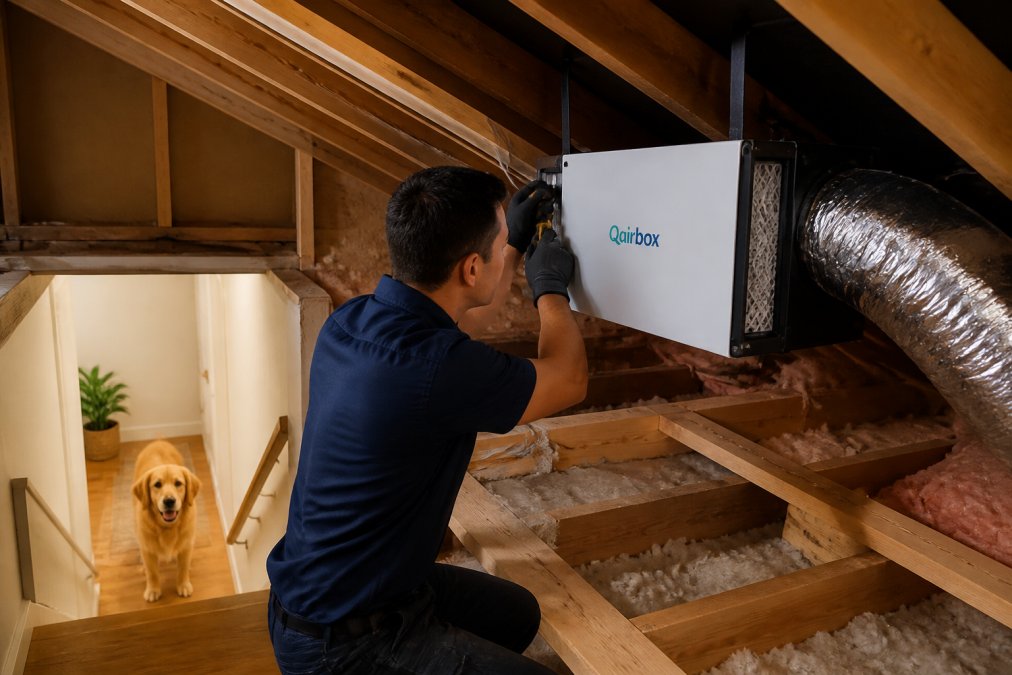
Whole-home air purification for pet dander changes the equation entirely. Instead of running several portable units in separate rooms, a single professionally installed system treats the entire house from one central location. A standalone, attic-mounted system runs quietly on its own 24/7, independent of your HVAC or central A/C.
The attic placement is deliberate. The system operates out of sight and out of mind, with no floor footprint. Because it runs continuously, it maintains a steady air exchange rate throughout the house, capturing dander and odors from every room rather than just the one where a portable unit happens to sit.
For allergy-sensitive households, the benefit is consistent, whole-home allergen reduction rather than spot treatment. The system is designed for hot, tightly sealed desert homes, where recirculated indoor air concentrates allergens and chemical irritants.
Filter Disposal Safety and Cost-Per-Year Reality Check
Filter disposal is rarely discussed in buying guides, but for pet owners it carries real health and environmental considerations. A spent filter is a concentrated collection of everything you have been trying to remove from your air.
The Health Risks of Handling a Saturated Pet Filter
A HEPA filter that has been running in a pet household for several months has captured significant dander, dust mite debris, and other allergens. When you pull that filter out of a portable unit, those trapped particles are disturbed. Handling it carelessly can resuspend a concentrated burst of allergens into your breathing zone.
A common pattern is for an allergy-sensitive person to change the filter without protection and then experience a flare-up within hours. The safest practice is to treat a used filter as a biohazard:
- Wear gloves and a mask when handling a spent filter.
- Remove the filter gently to minimize shaking and disturbance.
- Seal it immediately in a plastic bag before carrying it through the house.
- Wipe down the unit's interior with a damp cloth to capture any dislodged debris.
The Environmental Side of Carbon Disposal
Activated carbon is a finite resource, typically made from coal, coconut shells, or wood. Once saturated with adsorbed gases, it cannot be regenerated in a home setting. The carbon in a spent filter is loaded with whatever it adsorbed, litter box odors, cooking fumes, and volatile organic compounds. It is not hazardous waste in the regulatory sense, but it cannot be recycled.
For a household running multiple portable units, this means disposing of a dozen or more spent carbon filters per year, each a small package of adsorbed gases heading to a landfill. A whole-home system reduces this volume to a single filter change on a single schedule.
The Real Cost-Per-Year Comparison
The cost-per-year analysis is where the portable approach loses decisively. Consider a three-unit portable setup versus a single whole-home system:
Portable setup (3 units):
- 3 HEPA filters replaced 2× per year = 6 filters annually.
- 3 carbon pre-filters replaced 3× per year = 9 filters annually.
- Total: 15 filter purchases and disposal events per year.
Whole-home system (1 unit):
- 1 set of HEPA and carbon filters replaced on a single maintenance cycle.
- Total: 1 filter purchase and disposal event per year.
The difference is not just in the number of filters, it is in the consistency of the maintenance. A single annual or semi-annual schedule is easy to follow. A 15-filter-per-year schedule is one that most households will quietly abandon, leaving units running with exhausted filters that no longer clean the air.
Why a Single Maintenance Cycle Wins for Pet Owners
For a home with pets, the goal is not just to buy the right filter, it is to keep the system running at peak efficiency. A standalone, attic-mounted whole-home air purification system is professionally installed once and then operates on its own, quietly and out of sight, without connecting to your HVAC or central A/C. It simply runs 24/7, pulling air from the whole house and returning it clean.
That single point of maintenance is the practical advantage. One filter set, one schedule, one disposal event. It is a system designed for homeowners who want clean air without a monthly chore list.
Final Verdict: Which Filter Wins for Pet Owners?
The honest answer is that neither filter wins on its own. Pet owners need HEPA filtration to remove dander and particulate matter, and they need activated carbon to adsorb the odor gases that HEPA cannot touch. A system that combines both technologies, running continuously across the whole home, delivers the hypoallergenic environment that allergy-sensitive households need.
For most pet owners, the practical choice is a whole-home purification system rather than a collection of portable units. One professionally installed system in the attic cleans the entire house, runs quietly around the clock, and carries a single maintenance schedule. That is the standard recommended for homes where pets are part of the family.
Choosing the right air purification approach for a pet household comes down to matching technology to the specific contaminants you face. Dander needs HEPA; odors need carbon; both need continuous, whole-home coverage. Qairbox delivers hospital-grade purification throughout the entire house with a standalone, attic-mounted system that never touches your existing HVAC. Schedule a consultation to learn how whole-home purification can transform your home.
Frequently Asked Questions
Is a carbon filter better than a HEPA filter for pet odors?
Yes, for odors specifically. Carbon filters use activated carbon to trap gas molecules like the volatile organic compounds in litter box smells and pet urine. HEPA filters physically catch particles but do nothing for gases. For pet owners, you need both: HEPA for dander and carbon for odors. A standalone whole-home purification system combines both stages to handle the full range of pet-related pollutants.
Does a HEPA filter remove pet dander?
Yes. Pet dander consists of microscopic skin flakes that become airborne. A true HEPA filter, rated at HEPA H13 or higher, captures 99.97% of particles at 0.3 microns, which covers dander, dust mites, and pet hair fragments. The filtration efficiency depends on the air exchange rate and whether the unit is sized for the room or the whole house.
Why is a whole-home system more effective than portable filters for pet owners?
Portable units only clean the air in the room where they sit, leaving hallways, bedrooms, and living areas unprotected. Pet dander and odors travel throughout the house and settle on every surface. A standalone whole-home purification system, professionally installed in the attic, draws air from the entire living space and runs 24/7, maintaining consistent indoor air quality without the clutter or noise of multiple room units.
How often do carbon and HEPA filters need replacing in a whole-home system?
The maintenance cycle depends on your pet count and how tightly sealed your home is. In a whole-home purification system, filter replacement intervals can vary. Portable units with smaller filters saturate faster and require more frequent replacement. Check your system's maintenance schedule and monitor airflow to gauge filter saturation.