How Often to Change Air Purifier Filters With Pets
Table of Contents
- Why Pets Shorten Air Purifier Filter Life
- How Pet Hair and Dander Clog Filtration Media
- How Often to Change Air Purifier Filters With Pets: By Household
- Signs Your Air Purifier Filter Needs Changing
- Pre-Filters vs. Main Filters: What to Check and When
- Reducing Pet Odors in the Home With Better Air Purification
- Whole-Home Air Purification Maintenance: What a Low-Upkeep System Looks Like
- Frequently Asked Questions
Last Updated: September 10, 2026
Why Pets Shorten Air Purifier Filter Life
If you share your home with a dog or cat, your filtration system is working harder than you think. Pet dander, hair, and the oils that ride along with them load up filter media faster than almost any other indoor pollutant, which is why how often to change air purifier filters with pets in the house is a different calculation than for a pet-free home. This guide covers the household variables, warning signs, and maintenance rhythm that keeps clean air moving.
Pet dander is a mix of microscopic skin flakes, dried saliva, and protein particles that animals shed continuously. Those particles stay airborne for hours and coat filter fibers on contact, so filters saturate sooner, airflow drops, and the system works harder to push the same volume of air. Left alone, that means more dust recirculating and more strain on the equipment.
How Pet Hair and Dander Clog Filtration Media
Pet hair clogs filtration systems in two stages, and most homeowners only notice the second one. Long strands wrap around pre-filter screens and mat together, blocking airflow at the surface. Behind that blanket, fine dander and dust mites pack into the deeper media until the filter is saturated through its full thickness. A surface mat of hair is visible, but a saturated core is not, and it keeps restricting airflow long after the visible layer is gone, so clean air delivery falls even though the system is still running.
How Often to Change Air Purifier Filters With Pets: By Household
There is no single interval that fits every home, because pet count, coat type, and activity level all shift the timeline. Use this framework to set your first replacement cycle, then adjust based on what your filters look like when you pull them.
| Household Setup | Typical Replacement Window | What Drives It |
|---|---|---|
| One short-haired pet | Standard cycle, check monthly | Lower shedding volume |
| One heavy-shedding or double-coated pet | Shorter cycle, check every 2-3 weeks | Seasonal coat turnover |
| Two or more pets | Shortest cycle, inspect biweekly | Compounded dander load |
| Pets plus cooking and dust | Short cycle, inspect biweekly | Multiple particle sources |
Multi-Pet Household Variables
Multi-pet homes do not simply double the load, they compound it. Two dogs and a cat produce overlapping shedding cycles, so there is rarely a quiet period when the filter can recover. Add a bird or a long-haired breed and the fine-particle load climbs further, since lighter dander stays airborne longer and travels deeper into the media.
Track three variables to set your interval: how many pets shed heavily, whether any have double coats, and how much time they spend indoors. Homes where pets sleep on beds and sofas run dirtier than homes with outdoor-only animals. When in doubt, inspect more often than you think you need to.
Signs Your Air Purifier Filter Needs Changing
The clearest sign is visible loading: a filter that has turned gray or brown, holds a mat of hair on its face, or feels heavy compared to a fresh one is done. The useful skill is knowing what to look for before the filter is obviously finished, and when cleaning it is a waste of effort versus a genuine health risk.
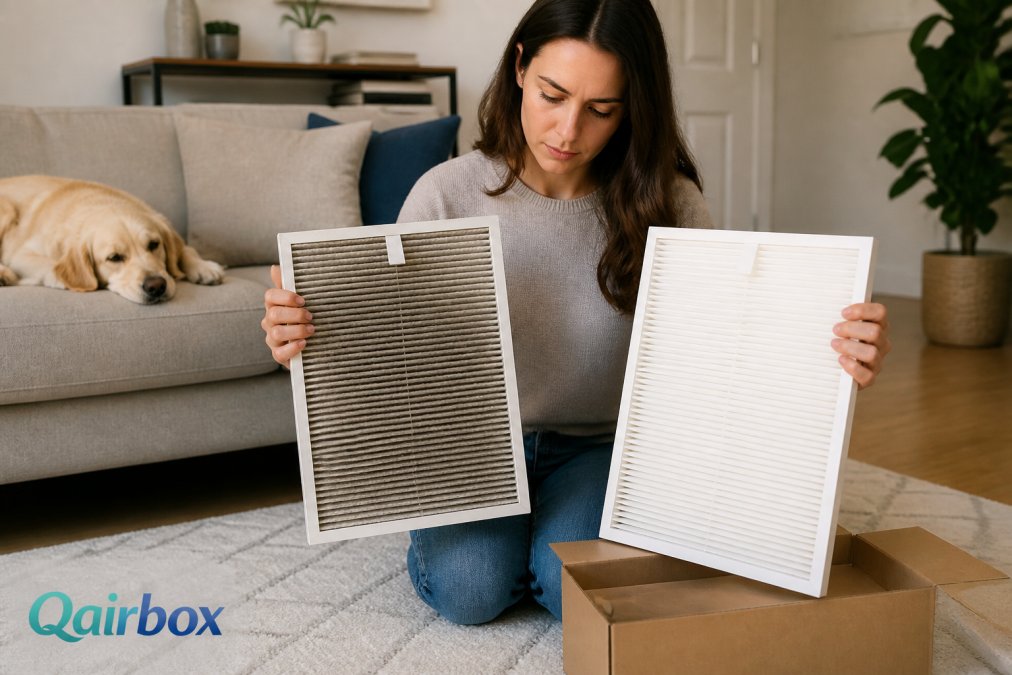
A Visual Inspection Guide: What Saturation Actually Looks Like
Most guides tell you to replace the filter when it looks dirty. That is not specific enough to be useful. Here is what to look for, stage by stage.
Pre-filter:
- Light gray fuzz, normal, still working. Vacuum and reuse.
- Mat of hair forming a continuous blanket, airflow is already restricted. Clean immediately.
- Hair pressed into the weave, not sitting on top, the pre-filter is loaded past the point where vacuuming helps. Replace it.
Main HEPA media:
- Uniform light gray, early loading, still functional.
- Dark gray or brown patches, especially near the intake side, the media is loading unevenly, which means airflow is already channeling around the loaded areas.
- Visible dust on the downstream (clean) side, the filter has failed. Particles are passing through. Replace immediately.
- Media that feels stiff or compressed, moisture or heavy loading has degraded the fibers. Replace.
Activated carbon layer:
- No visible change, carbon does not discolor as it saturates, which is why odor is the only reliable signal.
- Odors return within days of cleaning the room, the carbon is spent. Replace with the main filter.
Cleaning vs. Replacing: When Each One Actually Makes Sense
The decision is not about saving money on filters. It is about whether cleaning restores performance or just moves the problem around.
Clean the pre-filter when:
- It is a washable or vacuumable coarse screen.
- The main media behind it still passes the light test.
- You can fully dry it before reinstalling.
Replace the main filter when:
- The media fails the light test or shows dust on the clean side.
- Odors return faster than they used to.
- The filter has been in service through a full shedding season.
- You cannot remember when it was last changed.
Do not try to extend a main filter by cleaning it. Vacuuming HEPA media tears fibers and releases captured dander back into the room, the opposite of what you want in a pet home. A saturated main filter is a spent filter. There is no safe way to restore it.
Other Signals That Filtration Has Fallen Behind
Visible loading is the most reliable indicator, but these secondary signs matter too:
- Odors return faster after cleaning, especially pet smells that had faded
- Dust settles on surfaces within a day or two of wiping them down
- Allergy symptoms flare indoors, particularly in rooms where pets spend time
- The system runs louder or longer to achieve the same result
- A filter life indicator, if your system has one, reaches its threshold
For households where filters are tucked inside room units or behind grilles, this inspection rhythm is easy to forget. A professionally installed, attic-mounted whole-home air purification system runs out of sight on its own, removing the guesswork of managing multiple filters in multiple rooms. Maintenance becomes a single, predictable routine instead of a scavenger hunt.
Pre-Filters vs. Main Filters: What to Check and When
Pre-filters and main filters do different jobs, and treating them the same is where maintenance schedules fall apart. A pre-filter is a coarse screen that catches hair, lint, and large debris before they reach the main media. The main filter is the fine stage that captures dander, dust mites, and particulate matter. For pet owners, the pre-filter is your first line of defense.
Pet-Specific Filter Media: Not All HEPA Is Built for Dander
Two filters can both carry a HEPA label and behave completely differently in a home with pets.
- Standard mechanical HEPA traps particles by physical interception. It captures dander and hair well, but does nothing for the volatile compounds in saliva, urine, and skin oils that create pet odor.
- Carbon-activated media pairs a HEPA stage with an activated carbon layer that adsorbs odor molecules and many chemical irritants rather than letting them recirculate. In pet homes, this layer determines whether the air smells clean or just smells filtered.
- Pet-formulated blends add a pre-filter designed to grab hair before it mats, plus a carbon stage sized for odor load, so the fine media is not consumed by hair.
A common pattern: a standard HEPA filter in a pet home saturates on the particulate side while the odor side never gets addressed, so the homeowner replaces filters on schedule and still smells the dog. Matching the media to the problem matters more than the replacement interval.
When Cleaning Is Safe, and When It Is a Health Risk
Pre-filters are generally serviceable. Main media is not. The line between the two is where most pet owners get into trouble.
| Filter Stage | What It Catches | Safe to Clean? | Why |
|---|---|---|---|
| Pre-filter | Hair, lint, large debris | Yes, vacuum or rinse, then fully dry before reuse | Coarse screen, no fine media to damage |
| Main HEPA media | Dander, dust mites, fine particles | No, replace when saturated | Vacuuming tears fibers and releases trapped particles back into the air |
| Activated carbon layer | Odors, chemical irritants | No, replace with main filter | Carbon loses adsorption capacity permanently once saturated |
A few practical rules that hold up across most systems:
- Vacuum a pre-filter, never scrub it. Bristles and pressure push debris deeper into the weave.
- Rinse only if the manufacturer says the pre-filter is washable. A non-washable pre-filter that gets wet can grow mold.
- Let a washed pre-filter dry completely before reinstalling. A damp pre-filter feeds microbial growth right at the intake.
- Never vacuum a HEPA main filter. The media is designed to hold particles; disturbing it releases what it captured.
- Replace carbon when you replace the main filter. A carbon layer that has stopped adsorbing is just a restriction in the airflow path.
A Diagnostic Approach Instead of a Fixed Calendar
Rather than guessing at a number, inspect on a rhythm and let the filter tell you the truth. Check the pre-filter every two to three weeks in a pet home. Check the main media monthly. If the pre-filter is matted within a week, your household is producing more hair than a standard cycle can absorb, and the main media is loading faster than the label suggests. Shorten the interval accordingly.
For homes in hot, dusty climates, this diagnostic habit matters more than any published replacement window. Dust and pet dander stack on the same media, saturating a filter well before a pet-free home would ever need to think about it.
Reducing Pet Odors in the Home With Better Air Purification
Odor neutralization is a filtration job, not a masking job. Pet odors come from volatile compounds in dander, saliva, and urine that linger in the air and settle into fabrics. A system with an activated carbon stage traps those compounds rather than recirculating them, which is why filtration quality matters more than how often you light a candle.
For households dealing with pets and frequent cooking, odor control is a constant battle. The compounds that create smells are small and travel through the whole house, so a single room unit rarely keeps up. Whole-home purification addresses the source throughout the living space, pulling odors from every room rather than one corner.
Whole-Home Air Purification Maintenance: What a Low-Upkeep System Looks Like
Whole-home air purification maintenance looks different depending on the system type, and that difference shows up in how much of your time it consumes. A standalone, attic-mounted system runs on its own, independent of the home's heating and cooling equipment, so there is no filter to swap inside your living space.
That design matters for pet owners specifically. Instead of managing multiple room units, each with its own filter and replacement schedule, one professionally installed system handles the whole house from a single point. Qairbox builds QBox this way: installed in the attic, out of sight, running quietly around the clock to reduce odors, airborne particles, and chemical irritants throughout the home. It does not connect to or modify your existing HVAC or A/C system, so there is no ductwork project and no change to how your home heats and cools.
For allergy-sensitive families, the appeal is consistency. A system that runs continuously keeps particulate levels down between cleanings rather than spiking when a room unit is switched off. Maintenance stays simple: follow the manufacturer's filter guidance, keep an eye on performance, and let the system do its work out of view. If you want to know what a setup like this would look like in your home, schedule a consultation with Qairbox.
Frequently Asked Questions
Is it okay to leave my air purifier on 24/7 when I have pets?
Running purification continuously is usually the better choice in a pet household. Dander, hair and odors are released all day, and intermittent operation lets particulate matter settle onto surfaces before it can be captured. A standalone whole-home system installed in the attic is built to run quietly around the clock, so filtration never stops. If you use room units, expect filters to load faster when the unit runs constantly, and check them monthly.
How do I know if my air purifier needs a new filter?
Watch for four signals: visible gray or matted filter media, a musty or stale smell when the system runs, weaker airflow from the vents, and more frequent allergy symptoms or dust settling on furniture. A filter life indicator helps, but it is a timer, not a sensor. In homes with pets, pair the indicator with a monthly visual check, because heavy shedding seasons can saturate a filter well before the timer expires.
Are air purifiers effective at removing pet odors?
Particle filtration captures dander and hair, but odor molecules are gases, so they need activated carbon or a comparable gas-phase stage. That is why reducing pet odors in the home depends on both particulate and odor-neutralizing filtration working together. Whole-home purification that treats air continuously across the house tends to manage litter box, wet-dog and cooking odors more evenly than a single room unit running in one corner.
How does whole-home air purification maintenance compare to portable units for pet owners?
Portable units typically need filter checks or swaps every one to three months in a pet home, and each unit adds its own schedule. A standalone attic-mounted whole-home air purification system filters the entire house from one location, out of sight, with a single maintenance routine instead of one per room. Fewer filters to track means fewer missed replacements and more consistent air quality.
Pets and clean air can coexist, but only if your filtration keeps pace with what they shed. The right replacement rhythm, a clear pre-filter routine, and a system designed for whole-home coverage will do more for your indoor air than any single filter change. Qairbox installs standalone, attic-mounted whole-home purification that runs 24/7, stays out of sight, and is built for allergy-sensitive households with pets. Get started with Qairbox and breathe easier in every room.