How to Reduce Dust in Desert House: 7 Proven Steps
Table of Contents
- Why Desert Dust Is Different From Regular Household Dust
- Step 1: Seal Windows and Doors Against Dust Infiltration
- Step 2: Upgrade Your HVAC Filter With the Right MERV Rating for Dust
- Step 3: Control Dust at Entry Points With Doormats and Mudrooms
- Step 4: Establish a Regular Vacuuming and Dusting Routine
- Step 5: Install a Best Air Purifier for Desert Dust in Your Home
- Step 6: Manage Landscaping and Exterior Ground Cover to Reduce Dust
- Step 7: Address Pet Dander and Interior Dust Sources
Last Updated: August 5, 2026
Why Desert Dust Is Different From Regular Household Dust
Desert dust is fundamentally different from household dust in humid climates. The particles are finer, more abrasive, and infiltrate homes with relentless persistence. Desert dust consists primarily of soil particles, sand, and mineral matter blown across vast stretches of dry land. These particles are significantly smaller and more uniform than typical household dust, allowing them to penetrate deeper through tiny gaps and cracks. They remain suspended in air longer and travel farther into living spaces than heavier household dust in humid regions.
Desert homes are often sealed tightly to manage cooling costs, which creates a pressure imbalance that can actually draw more dust inside if entry points aren't properly managed. The dry air reduces humidity levels, so dust particles don't clump together readily and stay airborne longer. Generic dust-reduction advice fails in desert climates because standard vacuuming or basic air filters won't adequately address the volume and persistence of desert dust. You need a multi-layered approach combining exterior dust prevention, strategic entry-point control, and high-efficiency interior filtration.
Step 1: Seal Windows and Doors Against Dust Infiltration
Sealing windows and doors is your first line of defense against desert dust infiltration. Gaps around frames, weatherstripping, and door seals are where most airborne particles enter your home, especially during windy conditions.
Inspect all windows and doors for visible gaps or deteriorated weatherstripping. Run your hand around the perimeter of each frame; if you feel air movement, dust will follow that same path. Desert heat cycles cause materials to expand and contract, so even recently installed seals can develop issues.
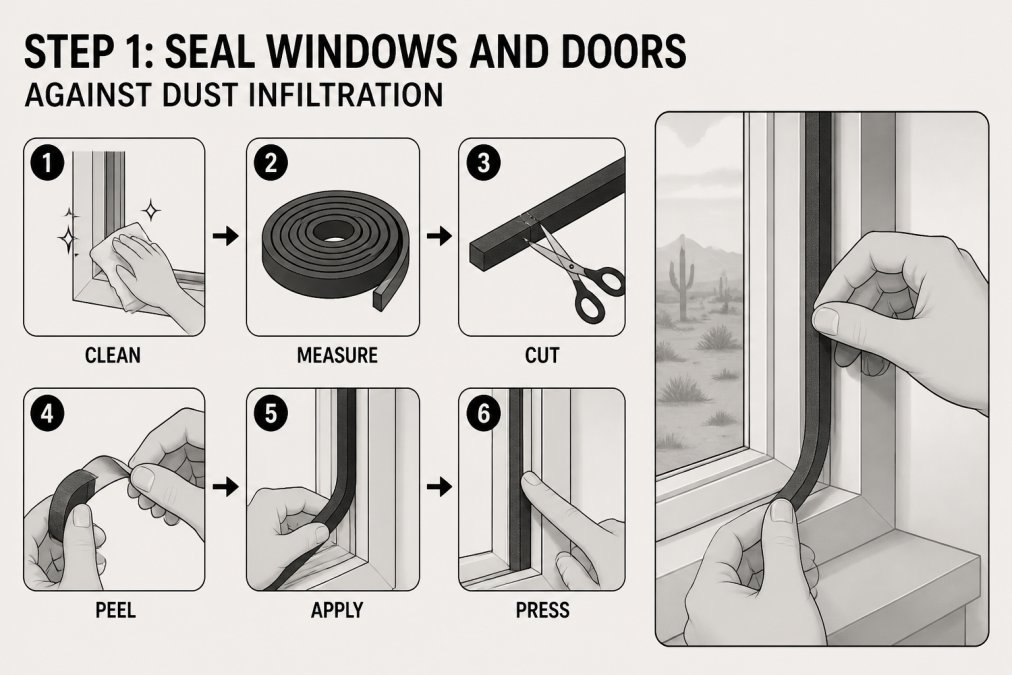
Apply quality weatherstripping tape or foam around the entire window frame. Adhesive-backed foam is cost-effective and easy to install but typically lasts 2-3 years in desert climates before needing replacement. Silicone-based weatherstripping lasts longer and handles desert conditions better.
For doors, replace weatherstripping along the top and sides, and install a door sweep at the bottom. The bottom seal is critical, it's where most dust enters because it's the largest gap. Magnetic door seals are durable, but adhesive-backed foam is adequate if you plan to replace it annually.
Caulk gaps between the window or door frame and the wall using paintable silicone caulk rather than acrylic. It remains flexible in desert heat and won't crack as easily. Pay special attention to corners and areas where different materials meet.
Step 2: Upgrade Your HVAC Filter With the Right MERV Rating for Dust
Your HVAC filter is your home's primary defense against airborne dust particles. Upgrading to the right MERV rating for desert dust conditions makes a measurable difference.
MERV ratings range from 1 to 16, with higher numbers indicating finer filtration. For desert dust reduction, use a MERV 11-13 filter, which captures particles as small as 1 micron, the size range where most desert dust particles fall. MERV 13 is ideal if your HVAC system can handle the increased air resistance without straining the blower motor.
Check your furnace or air handler unit to confirm the filter size and your system's maximum recommended MERV rating. Most modern HVAC systems can handle MERV 13 without issues, but older systems may need MERV 11 to avoid reduced airflow.
Replace your HVAC filter every 30 days during heavy dust seasons and every 60 days during quieter periods. A clogged filter reduces airflow and forces dust particles to bypass the filter entirely. Use pleated filters rather than flat fiberglass filters; they have more surface area, capture more dust, and maintain better airflow.
For homes where dust control is critical, a whole-home air purification system integrated with your HVAC provides additional filtration beyond what a furnace filter alone can achieve. A system like Qairbox integrates seamlessly into your existing HVAC infrastructure and operates continuously, capturing particles that pass through your furnace filter and circulating clean air throughout your entire home without the maintenance burden of multiple standalone units.
Step 3: Control Dust at Entry Points With Doormats and Mudrooms
Most dust enters your home on shoes and clothing. Controlling dust at entry points before it reaches your living spaces prevents it from spreading throughout your home.
Install high-quality doormats both outside and inside each exterior door. The outdoor mat should be coarse and textured to scrape dust and sand off shoes. The indoor mat should be absorbent and designed to trap fine particles. Together, they create a two-stage filtration system that removes the majority of dust before it travels deeper into your home.
If you have the space, create a small mudroom or entryway buffer zone with a mat, shoe rack, and small bench. This gives people a designated space to remove or wipe down shoes before entering the main living area. Encourage household members to remove shoes at the door; this single behavioral change cuts indoor dust substantially because shoes are the primary vector for ground dust and sand.
For pet owners, designate a cleaning station near the door where you can wipe paws with a damp cloth before pets enter living spaces. Pet paws pick up enormous amounts of dust and sand and distribute it throughout your home as they walk.
Step 4: Establish a Regular Vacuuming and Dusting Routine
A consistent vacuuming and dusting routine is essential for managing dust that inevitably makes it past your entry-point controls and filtration systems. Vacuum high-traffic areas at least twice weekly and less-used areas once weekly. Desert dust accumulates faster than in other climates.

Use a vacuum with a HEPA filter; standard vacuums blow fine particles back into the air. HEPA-filtered vacuums capture particles down to 0.3 microns and contain them in the bag or canister. Empty the canister or replace the bag frequently; a full vacuum loses efficiency.
For dusting, use microfiber cloths rather than dry dusting methods. Microfiber attracts dust electrostatically and traps it instead of spreading it into the air. Lightly dampen your microfiber cloth with water to increase electrostatic attraction and prevent dust from becoming airborne.
Dust in a systematic pattern from top to bottom so particles you dislodge fall onto areas you haven't cleaned yet. Pay special attention to ceiling fans, baseboards, window sills, and cabinet tops, these accumulate dust faster in desert climates and become secondary sources of airborne particles if not cleaned regularly.
Step 5: Install a Best Air Purifier for Desert Dust in Your Home
A dedicated air purification system provides continuous filtration beyond what your HVAC system alone can achieve. For homes in desert climates, a whole-home air purifier is more effective than multiple room-based units because it cleans air throughout your entire home simultaneously.
An effective air purifier for desert dust integrates with your existing HVAC system rather than operating as a standalone unit. Look for systems with HEPA filtration rated to capture particles at 0.3 microns or smaller. Activated carbon filters are a bonus if odor control is important.
For homeowners seeking a professional-grade solution that minimizes maintenance, Qairbox delivers hospital-grade air purification integrated directly into your HVAC system. The system is installed discreetly in your attic, operating quietly 24/7 without requiring multiple units throughout your home. It integrates seamlessly with your existing HVAC setup without modifications, making it ideal for tightly sealed desert homes. Professional installation ensures optimal performance for reducing airborne particles, odors, and chemical irritants throughout your entire residence.
Step 6: Manage Landscaping and Exterior Ground Cover to Reduce Dust
Your exterior landscaping has a direct impact on how much dust enters your home. Bare soil and sparse vegetation are major dust sources in desert climates.
Replace bare soil with ground cover plants or mulch. Native desert ground covers like creeping mahonia, desert rose, or various sedums stabilize soil and prevent wind from lifting particles into the air. If plants don't work, use wood mulch or rock mulch to cover exposed soil.
Avoid fine gravel or sand in landscaping immediately adjacent to your home. Use larger river rock or pea gravel that doesn't blow as easily, or use mulch and living ground cover instead.
Plant windbreaks on the side of your home facing prevailing winds. Native shrubs or small trees create a barrier that slows wind speed and reduces the dust load reaching your home's walls and windows.
Step 7: Address Pet Dander and Interior Dust Sources
While desert dust from outside is the primary concern, interior dust sources, particularly pet dander, compound the problem. Regular grooming removes loose fur and skin cells before they become airborne. Bathe pets monthly and brush them at least twice weekly, preferably outdoors.
Wash pet bedding weekly in hot water, which kills dust mites and removes accumulated dander. Keep pets out of bedrooms if possible, and definitely off beds. If pets must be in bedrooms, use air purification in that room to minimize dander accumulation.
Address other interior dust sources. Minimize dry cleaning plastic bags, cardboard boxes, and paper products in living spaces. Vacuum upholstered items weekly with a HEPA filter. Use your range hood when cooking, and ensure it vents outside rather than recirculating air. Minimize scented laundry products and air fresheners, which release volatile organic compounds that can interact with dust particles.
Reducing dust in a desert house requires a comprehensive approach that addresses both external infiltration and internal sources. The most effective strategy combines multiple layers: sealing entry points, upgrading HVAC filtration, managing landscaping, and establishing consistent cleaning routines. For homeowners seeking a professional solution that handles continuous air purification without the maintenance burden of multiple units, Qairbox offers hospital-grade filtration integrated into your existing HVAC system. The seamless installation and 24/7 operation make it ideal for allergy-sensitive households in tightly sealed desert homes. Schedule a consultation with Qairbox to learn how professional-grade air purification can transform your indoor air quality and reduce the dust that affects your home and health.
Frequently Asked Questions
How often should you change HVAC filters in a desert climate?
In desert climates with high dust levels, replace your HVAC filters every 1 to 2 months instead of the standard 3-month interval. Check filters monthly for visible dust buildup. If you use a higher MERV-rated filter (MERV 11-13), change them every 6-8 weeks, as denser filters clog faster with fine desert particulates. Homes with pets or multiple occupants may need even more frequent changes.
Will a whole-home air purifier integrated with my HVAC actually reduce dust if my house is already sealed tight?
Yes. Tightly sealed desert homes trap airborne particles and contaminants inside, making whole-home air purification more effective. A system that integrates with your HVAC circulates and filters all interior air continuously, removing dust, allergens, and fine particles that settle on surfaces. Since sealed homes limit outdoor air exchange, this type of purification works harder and delivers noticeable results for allergy-sensitive households.
What's the difference between sealing windows and installing an air purifier for reducing dust?
Sealing windows and doors prevents dust from entering your home in the first place, reducing the dust load. An air purifier removes dust and particles already inside your home by filtering the air continuously. For maximum dust reduction in a desert house, use both strategies: seal entry points to limit infiltration and run a whole-home air purifier to clean the air that does circulate indoors.
Can I install a whole-home air purification system with my existing HVAC setup?
Most whole-home systems integrate seamlessly with existing HVAC equipment without requiring modifications or replacement. Professional installation assesses your current ductwork and airflow to ensure proper placement and operation. Systems installed in the attic work with your existing furnace and air handler, making them ideal for homes with established HVAC systems that you want to keep.