How to Stop Air Purifier Noise: 7 Fixes That Work
Table of Contents
- Why Air Purifier Noise Happens: Common Causes at a Glance
- Step 1: Fix Air Purifier Rattling Noise by Checking for Foreign Objects
- Step 2: How to Clean Air Purifier Filter to Reduce Noise
- Step 3: Troubleshoot Air Purifier Fan Grinding and Whistling Sounds
- Step 4: Correct Unit Placement to Stop Air Purifier Noise from Airflow Obstruction
- Step 5: Vibration Dampening Techniques That Actually Reduce Noise
- Step 6: Use Fan Speed Settings and Smart Home Controls to Manage Noise
- Common Mistakes to Avoid When Fixing Air Purifier Noise
Last Updated: August 4, 2026
Knowing how to stop air purifier noise is more useful than most guides let on. A noisy unit is often a unit that gets switched off, defeating the entire purpose. The fixes below are ranked by frequency of occurrence. Work through them in order and you'll solve the problem in one session.
Most guides tell you to "check the filter" and stop there. Filter issues cause maybe half of all air purifier noise complaints. The other half come from placement, vibration, fan mechanics, and operating settings. This guide covers all of it.
Why Air Purifier Noise Happens: Common Causes at a Glance
Air purifier noise is any sound outside the unit's normal operating range, rattling, grinding, whistling, or excessive hum. Understanding the source before troubleshooting saves significant time.
The most common causes, in order of frequency:
- Clogged HEPA filter creating back-pressure on the fan
- Foreign objects lodged in the intake vent or fan housing
- Fan blade misalignment or debris on the blades
- Worn motor bearings producing grinding or squealing
- Poor unit placement on uneven or resonant surfaces
- Fan speed set too high for the room's acoustic tolerance
Normal Operating Sounds vs. Mechanical Failure
Normal operating sounds include a low, consistent hum from the motor and steady airflow resembling white noise. Mechanical failure sounds are irregular, change pitch under load, or appear suddenly in a previously quiet unit.
If the sound started gradually over weeks, it's almost always a maintenance issue. If it started overnight, suspect a foreign object or failing motor bearing.
Decibel Level Benchmarks: What's Too Loud?
Most residential air purifiers operate between 25 and 55 decibels depending on fan speed. At low speed, a well-maintained unit should sit around 25-35 dB, roughly equivalent to a quiet library. At high speed, 45-55 dB is typical. Anything above 60 dB indicates a problem worth diagnosing. According to EPA guidance on indoor noise levels, sustained indoor noise above 45 dB can interfere with sleep quality.
| Noise Source | Typical Decibel Range | What It Suggests |
|---|---|---|
| Normal low-speed operation | 25-35 dB | Unit is healthy |
| Normal high-speed operation | 45-55 dB | Expected performance |
| Rattling or vibration noise | 50-65 dB | Foreign object or surface issue |
| Grinding or squealing | 55-70 dB | Motor bearing or fan blade problem |
| Whistling or high-pitched whine | 45-65 dB | Clogged filter or airflow obstruction |
Step 1: Fix Air Purifier Rattling Noise by Checking for Foreign Objects
Rattling is almost always caused by something inside the unit that doesn't belong there. This is the first thing to rule out.
How to check:
- Power off and unplug the unit completely.
- Remove the outer panel or grille.
- Shine a flashlight into the intake vent and fan housing.
- Look for dust clumps, debris, coins, or pet hair.
- Use a soft brush or compressed air to clear the intake vent.
- Rotate the fan blade gently by hand to check for resistance.
- Reassemble, plug in, and test at low speed.
A foreign object contacting the fan blade will produce rhythmic clicking or rattling that scales with fan speed.
Step 2: How to Clean Air Purifier Filter to Reduce Noise
A clogged filter is the single most common cause of air purifier noise. It restricts airflow, forcing the fan to work harder and spin faster. The increased back-pressure causes vibration in the housing, resulting in a strained-sounding unit.
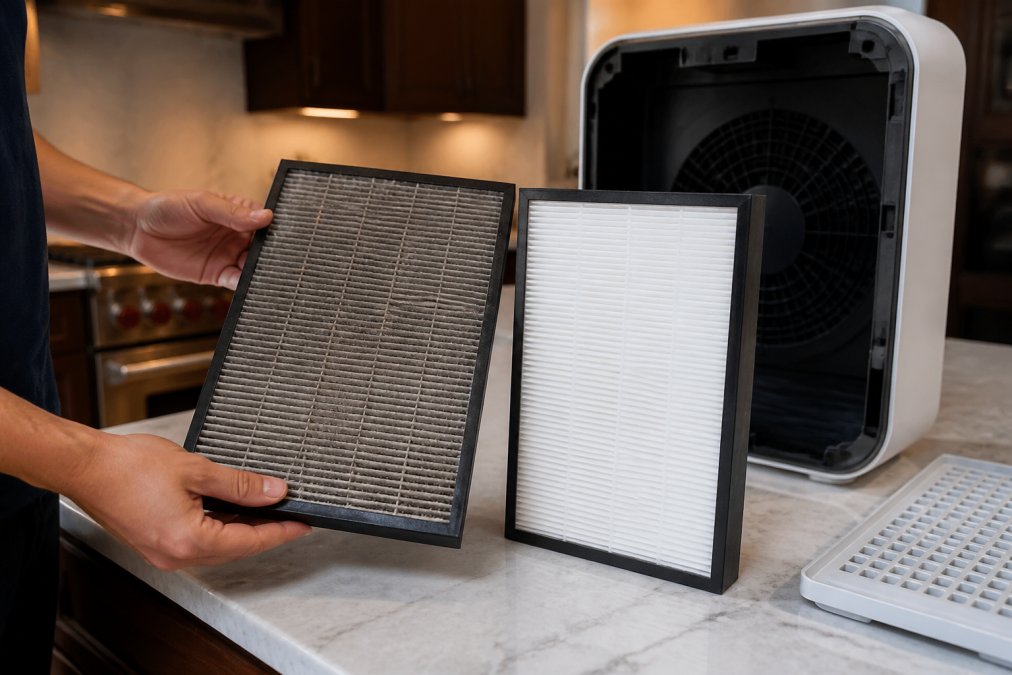
To clean the filter correctly:
- Power off and unplug the unit.
- Remove the filter according to your model's manual.
- Take the filter outside or over a trash can and tap gently to dislodge loose dust.
- For pre-filters, rinse with cool water and allow to dry completely (at least 24 hours) before reinstalling.
- True HEPA filters cannot be washed. Use compressed air on low pressure only.
- Wipe down the interior filter chamber with a dry microfiber cloth.
- Reinstall and test.
According to EPA indoor air quality guidance on air cleaners, HEPA filters capture particles as small as 0.3 microns, but efficiency drops significantly when saturated with dust.
When Cleaning Isn't Enough: Filter Replacement Schedule
Most HEPA filters need replacing every 6-12 months depending on usage intensity and air quality. Homes with pets, heavy cooking, or desert climates often push toward the 6-month end.
Signs a filter needs replacement:
- Persistent whistling sound even after cleaning
- Visible discoloration or structural damage to the filter media
- Noticeably reduced airflow from the output vent
- Odors that weren't present when the filter was new
Step 3: Troubleshoot Air Purifier Fan Grinding and Whistling Sounds
Grinding and whistling are mechanical sounds that require more than routine maintenance to fix.
Whistling is almost always an airflow problem. It happens when air is forced through a restricted opening at high velocity. The fix is usually a clogged filter, blocked intake vent, or unit placed too close to a wall.
Grinding indicates friction between moving parts that shouldn't be touching. The two most common sources are debris on the fan blade and worn motor bearings.
Checking Motor Bearings and Fan Blade Alignment
Fan blade alignment issues produce rhythmic scraping or ticking. Motor bearing failure produces continuous grinding or squealing that worsens as the unit warms up.
To diagnose:
- Run the unit at low speed for two minutes, then increase to high speed.
- If grinding intensifies with speed, suspect the fan blade or debris.
- If grinding is consistent regardless of speed and worsens over 10-15 minutes, suspect motor bearings.
- Inspect the fan blade visually for cracks, warping, or debris.
- Check that the blade is centered in the housing with equal clearance on all sides.
DIY Motor Lubrication: What You Need to Know
Some air purifier motors use sleeve bearings that can be lubricated. Others use sealed ball bearings that cannot. Check your unit's service manual before attempting this.
If your model supports lubrication:
- Use light machine oil or sewing machine oil only. Do not use WD-40.
- Apply one or two drops to the motor shaft access point only.
- Run the motor for 30 seconds to distribute the oil.
- Wipe away any excess.
Step 4: Correct Unit Placement to Stop Air Purifier Noise from Airflow Obstruction
Placement is underrated as a noise fix. A unit against a wall or on a vibration-amplifying surface will be significantly louder than the same unit placed correctly.
General placement rules that reduce noise:
- Maintain at least 12-18 inches of clearance on all sides, including back and top.
- Place on a hard, flat surface rather than carpet.
- Keep away from corners, which trap and amplify sound.
- In a well-ventilated area, the unit works with natural air circulation, reducing the fan speed needed.
Restrict airflow and the fan compensates by spinning faster. A faster fan is a louder fan. Correct placement is a passive noise reduction technique.
Step 5: Vibration Dampening Techniques That Actually Reduce Noise
Hard surfaces transmit vibration efficiently. A purifier on hardwood or tile transfers motor vibration into the floor, which amplifies the sound.
Effective vibration dampening options:
- Anti-vibration rubber mats (the type used under washing machines) cut transmitted vibration significantly.
- Silicone furniture pads on each foot provide a simpler alternative.
- A folded microfiber cloth under the unit is a free, immediate fix that works surprisingly well.
- Check that all housing panels are seated correctly. Loose panels vibrate against the chassis and add buzzing.
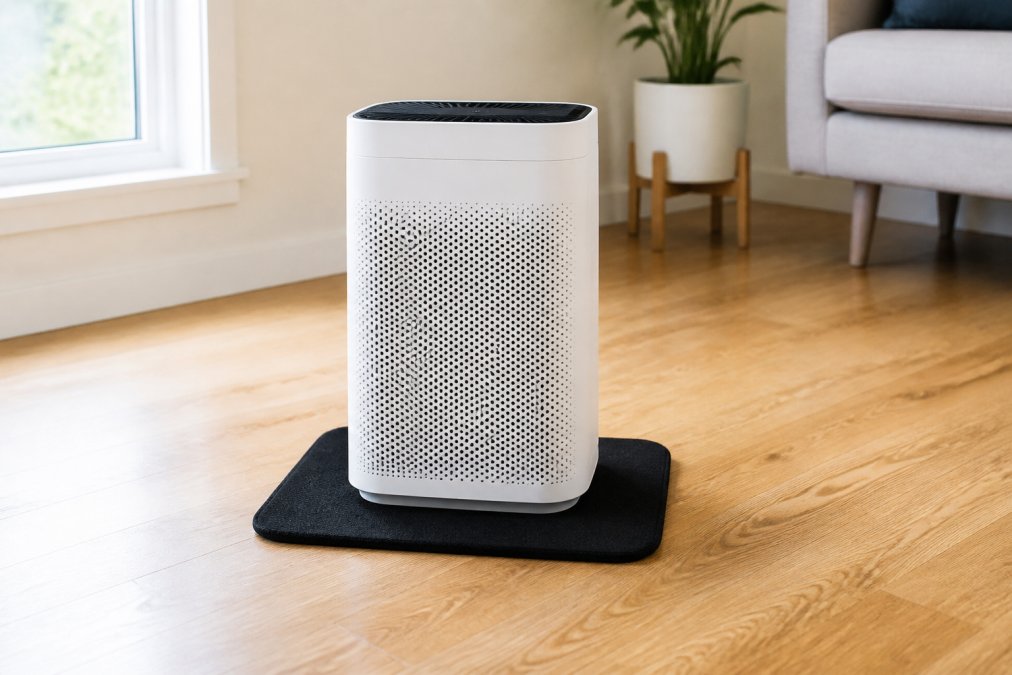
Acoustic dampening at the source is more effective than soundproofing around the room.
Step 6: Use Fan Speed Settings and Smart Home Controls to Manage Noise
The simplest noise reduction strategy is running the unit at lower fan speed. Many users set their purifier to maximum and leave it there. A unit at 30-40% fan speed in a properly sized room maintains good air quality with significantly less noise.
For households with smart home systems:
- Schedule the unit to run at high speed during unoccupied hours and low speed during sleep.
- Use a smart plug with scheduling capability if your unit lacks built-in Wi-Fi control.
- Some newer units support voice assistant integration.
Lower fan speed means slower air circulation and longer time to clean a given volume of air. The practical solution is matching fan speed to occupancy. According to ASHRAE indoor air quality standards and guidance, adequate air changes per hour doesn't always require maximum fan speed in well-sealed rooms.
Common Mistakes to Avoid When Fixing Air Purifier Noise
Replacing the filter when the problem is mechanical. A new filter won't stop grinding from worn motor bearings.
Running the unit at maximum speed indefinitely. This accelerates filter clogging, increases motor wear, and creates more noise.
Placing the unit in a corner for aesthetics. Corners are acoustically the worst location and reduce effectiveness.
Skipping the vibration check. Many users clean the filter when the unit is still buzzing from vibration transfer.
Ignoring gradual noise increases. A unit getting louder over weeks usually means filter saturation or progressive bearing wear. Catching it early is cheaper than addressing failure.
For households dealing with severe allergies, pet dander, or cooking odors, maintenance frequency matters as much as the steps themselves. According to American Lung Association guidance on indoor air quality, indoor air can carry two to five times the concentration of pollutants found outdoors, making a poorly maintained or switched-off purifier a meaningful health gap.
Persistent air purifier noise is solvable by working through the actual cause rather than defaulting to quick fixes. For households wanting whole-home air purification without noise, maintenance burden, or placement constraints, Qairbox integrates hospital-grade air purification directly into your existing HVAC system, installing discreetly in the attic and operating quietly 24/7. Schedule a consultation with Qairbox to find out whether a whole-home HVAC-integrated system is right for your home.
Frequently Asked Questions
Why is my air purifier making a loud grinding noise?
A grinding noise almost always points to the fan housing or motor bearings. Debris caught between the fan blade and housing is the most common cause, but worn motor bearings or a fan blade knocked out of alignment can produce the same sound. Power the unit off, remove the filter panel, and visually inspect the fan area for foreign objects or visible damage. If the grinding continues after clearing debris, the motor bearings may need lubrication or the fan assembly may need replacement.
Can a dirty filter cause an air purifier to be loud?
Yes. A clogged HEPA filter forces the fan to work harder to pull air through, increasing back-pressure and fan speed. That extra strain raises the decibel level noticeably and can eventually stress the motor. Cleaning or replacing the filter is one of the fastest ways to reduce air purifier noise. Most manufacturers recommend inspecting filters every 30 days and replacing them every 6 to 12 months depending on usage and air quality conditions in your home.
Is it normal for an air purifier to make a whistling sound?
A faint white noise hum is normal, but a whistling sound usually signals airflow obstruction. The intake vent may be partially blocked by furniture, curtains, or a wall, creating turbulence as air is forced through a restricted opening. Check that the unit has at least 12 to 18 inches of clearance on all sides. A whistling sound can also indicate a filter that is slightly misaligned in its housing, which creates a gap that air rushes through at high velocity.
How can I make my air purifier quieter at night?
Switch the unit to its lowest fan speed or a dedicated sleep mode if available. Place it on a flat, hard surface with a rubber anti-vibration mat underneath to reduce transmitted vibration. Move it at least 6 to 10 feet from your bed so the decibel level drops with distance. If your unit connects to a smart home system, schedule it to run on high during the day and drop to low fan speed automatically at bedtime. A clean filter also makes a meaningful difference in overnight noise levels.
When should I replace my air purifier fan motor?
Replace the fan motor when grinding or rattling persists after you have cleared debris, cleaned the filter, and checked housing alignment. Other signs include the fan spinning visibly slower than normal, the unit shutting off due to overheating, or a burning smell during operation. Motor replacement is typically a job for a qualified appliance technician. If repair costs approach the price of a new unit, replacement is usually the more practical choice. Check your unit's warranty before paying for any motor repair.
How do I stop air purifier rattling noise caused by vibration?
Rattling from vibration is usually caused by the unit sitting on an uneven or resonant surface. Place a thick rubber mat or anti-vibration pad under the unit to absorb movement. Check that all filter panels and housing covers are fully seated and latched, since loose panels amplify vibration significantly. If the rattle only appears at high fan speed, reduce the operating mode one level. For persistent cases, acoustic dampening foam strips applied around the housing seams can reduce transmitted vibration further.