Whole Home Air Purification for Allergies: A 2026 Guide
Table of Contents
- How Whole Home Air Purification Works for Allergies
- MERV 13 vs HEPA for Home HVAC Systems
- Key Features to Look for in a Whole Home Air Purifier
- How to Improve Indoor Air Quality for Allergy Sufferers
- Whole Home Air Purifier Maintenance Schedule
- Cost of Whole House Air Purifier Installation
- Whole Home vs. Portable Air Purifiers for Allergies
- Conclusion
Last Updated: August 6, 2026
How Whole Home Air Purification Works for Allergies
Whole home air purification filters your entire home's air supply through your existing HVAC system, trapping allergens before they circulate through living spaces. Unlike portable units, it treats air at the source by pulling air through return ducts, passing it through progressively finer filtration stages, and delivering cleaned air back into your home. For allergy sufferers, this continuous circulation means airborne allergens like pollen, dust mites, and pet dander spend less time in your breathing space.

HEPA Filtration and Particulate Matter Removal
A true HEPA filter captures 99.97% of particles 0.3 microns and larger, covering the vast majority of common allergens including pollen grains and dust mite debris. The filtration process works through three mechanisms: mechanical interception, where particles collide with fibers; impaction, where larger particles get trapped; and diffusion, where tiny particles eventually adhere to fibers.
HEPA effectiveness depends entirely on airflow. A HEPA filter installed in a system with poor airflow becomes a bottleneck that reduces air circulation. Professional installation ensures your HVAC system can handle the additional static pressure without compromising performance.
Integration with Your Existing HVAC System
Whole home air purification integrates directly into your furnace or air handler, sitting between your return air plenum and furnace to filter all air before it passes through your heating or cooling coil. Modern HVAC systems are designed to accommodate aftermarket filtration without modification to existing ducts, blower, or thermostat.
A properly sized system adds minimal resistance. The static pressure increase is usually negligible, as most modern furnaces are rated for the additional load.
MERV 13 vs HEPA for Home HVAC Systems
MERV 13 filters capture particles down to 0.3 microns with 90% efficiency, while HEPA filters capture the same particle size range at 99.97% efficiency. For allergy sufferers, HEPA is superior because it removes nearly all particulate allergens from circulating air.
The trade-off is airflow restriction. HEPA filters create higher static pressure, requiring proper installation so your blower can push air through denser media without overworking. MERV 13 can be used as a pre-filter stage before HEPA to extend the HEPA filter's life.
According to EPA guidance on residential air filtration, HEPA filtration is the most effective option for removing allergens and fine particulate matter from indoor air.
Key Features to Look for in a Whole Home Air Purifier
When evaluating whole home air purification, focus on three core specifications: CADR rating, filter efficiency, and system compatibility with your HVAC.
The CADR (Clean Air Delivery Rate) tells you how much filtered air the system delivers per minute. For whole home systems, CADR should match your home's total volume and your HVAC blower's capacity. Look for systems using true HEPA media certified to the 99.97% standard with a filter micron rating of 0.3 microns or smaller.
Sealed installations prevent bypass, ensuring air flows through the filter rather than around it. Some systems include activated carbon stages for volatile organic compounds (VOCs) and odors, which matters if you have chemical sensitivities.
CADR Ratings and Air Changes Per Hour
For allergy sufferers, the pollen CADR is most relevant. A CADR of 300+ for pollen indicates strong performance. Air changes per hour (ACH) describes how many times your system cycles your entire home's air through the filter. The EPA recommends 4-6 ACH for effective allergen removal.
To calculate required CADR, multiply your home's cubic footage by your target ACH and divide by 60. A 2,000 square foot home with 8-foot ceilings (16,000 cubic feet) targeting 5 ACH needs a CADR of approximately 1,333 for pollen. Whole home systems typically achieve 6-12 ACH depending on home size and blower capacity.
Addressing VOCs and Chemical Irritants
For people with chemical sensitivities, a HEPA-only system isn't sufficient. Look for systems with activated carbon filtration as a secondary stage to absorb VOCs and odors. The thickness and quality of the activated carbon layer determine how long it remains effective before needing replacement.
How to Improve Indoor Air Quality for Allergy Sufferers
Beyond whole home air purification, source control is critical. Wash bedding weekly in hot water, use allergen-proof mattress covers, and manage pet dander through regular grooming. Keeping indoor humidity between 30-50% reduces dust mite populations without drying out your home.
Regular HVAC maintenance ensures your whole home system performs consistently. Dirty blower wheels reduce airflow, and sealed ductwork prevents air leaks that bypass your filtration. A professional should inspect your system annually.
Placement and Airflow Optimization
The unit should be positioned to minimize ductwork length between the return air plenum and the filter. Longer ductwork increases static pressure and reduces efficiency. Smooth transitions between ducts and the filter housing prevent turbulence that reduces filtration effectiveness.
Smart Home Integration for Monitoring and Control
Modern whole home systems integrate with smart home platforms, allowing remote monitoring of filter status and air quality. Smart thermostats work with whole home filtration to optimize both heating/cooling and air cleaning. You can schedule higher filtration during high pollen seasons or adjust fan speed based on detected air quality.
Whole Home Air Purifier Maintenance Schedule
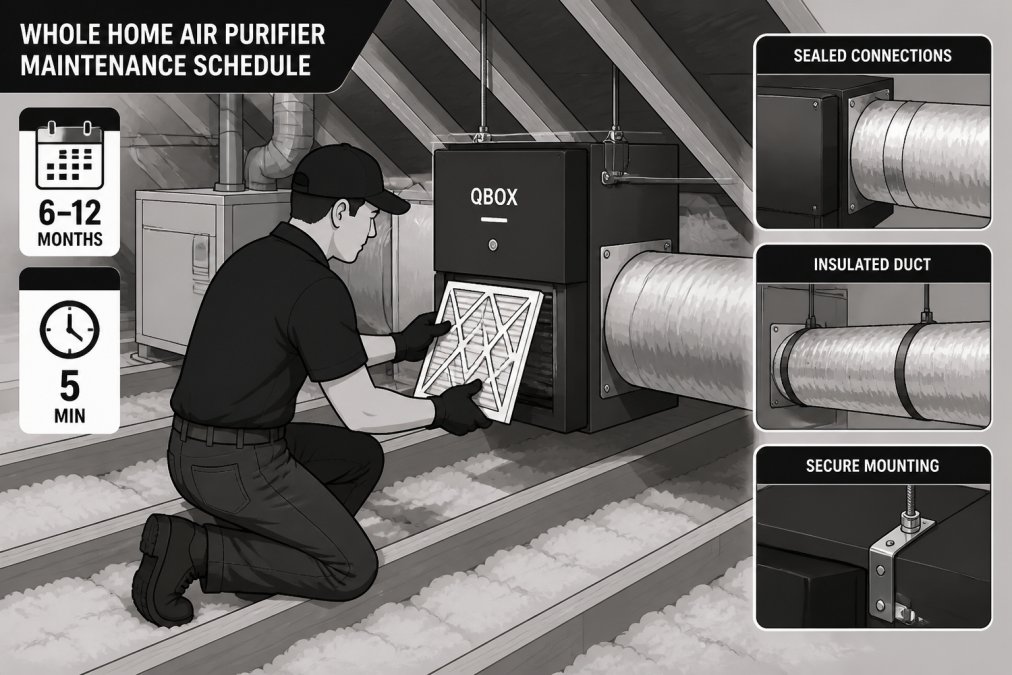
Filter replacement is the primary maintenance task. HEPA filters typically last 12-18 months depending on home conditions, pets, and air quality. Pre-filters may need replacement every 3-6 months, and activated carbon filters last 6-12 months.
Beyond filter changes, annual professional inspections verify that ductwork seals remain intact and the blower operates efficiently. Many homeowners set phone reminders or subscribe to filter delivery services to prevent missed replacements. Some systems include filter life indicators that alert you when replacement is due.
Cost of Whole House Air Purifier Installation
The total investment includes equipment cost, professional installation, and long-term maintenance.
Professional Installation and HVAC Compatibility
Professional installation ensures your system integrates properly with your existing HVAC without compromising performance. The technician assesses your blower capacity, ductwork configuration, and return air plenum to determine optimal installation location.
Qairbox delivers hospital-grade air purification with professional installation included, ensuring your system is sized and positioned correctly for your home's HVAC capacity and layout.
Energy Consumption and Long-Term Operating Costs
Whole home air purification adds a small load to your HVAC system's blower. Modern variable-speed blowers adjust output based on demand, using more energy only when actively filtering. During mild seasons, energy consumption is minimal.
Long-term operating costs include electricity for blower operation and filter replacement. Compared to running multiple portable air purifiers, a whole home system is typically more energy-efficient. For homeowners with severe allergies, the energy cost is offset by improved air quality and fewer allergy symptoms.
Whole Home vs. Portable Air Purifiers for Allergies
Portable units excel in targeted applications, cleaning a bedroom or office, but create only localized clean air zones. Whole home systems clean all air before it circulates through your home, making your entire residence the protected zone.
Maintenance differs significantly. Portable units require filter replacement for each unit plus regular cleaning. Whole home systems have a single filter replacement schedule and minimal user maintenance. Portable units can be audible at higher fan speeds, while whole home systems installed in attics operate silently.
The upfront investment in a whole home system is higher, but the long-term value, lower energy consumption, less maintenance, quieter operation, and superior air quality, favors whole home systems for allergy sufferers committed to comprehensive air cleaning.
Allergies rob you of comfort in your own home. A whole home air purification system addresses the root cause by removing allergens continuously. Qairbox's hospital-grade system integrates seamlessly with your existing HVAC, operates silently from your attic, and requires minimal maintenance, delivering cleaner air 24/7. To learn how whole home air purification can transform your indoor air quality and reduce allergy triggers, Schedule Consultation with the Qairbox team for a personalized assessment of your home's needs.
Frequently Asked Questions
Are whole home air purifiers effective for allergies?
Yes, whole home air purifiers are effective for allergies when properly sized and maintained. Systems using HEPA filtration can capture 99.97% of airborne allergens like pollen, dust mites, and pet dander down to 0.3 microns. The key is selecting a unit with adequate CADR ratings for your home's square footage and ensuring it processes your home's air multiple times per hour. Professional installation ensures optimal airflow and filter efficiency.
What is the best MERV rating for allergy sufferers?
For allergy sufferers, MERV 13 filters are the minimum standard, capturing particles as small as 0.3 to 1 micron. However, HEPA filtration (which exceeds MERV ratings) is superior for whole home systems, removing 99.97% of airborne particles. MERV 13 works well in standard HVAC systems without modifications, while HEPA requires compatible equipment. The choice depends on your existing HVAC system's capacity and your allergy severity.
How often should you change whole home air filters for allergies?
Standard whole home air filters should be changed every 1 to 3 months, depending on usage, pets, and indoor air quality. Allergy sufferers in high-pollen areas or homes with pets may need more frequent changes. Pre-filters extend the life of primary filters by capturing larger particles first. Professional systems often include monitoring features that alert you when replacement is needed, reducing guesswork and ensuring consistent filtration performance.
Do whole house air purifiers remove dust and pet dander?
Yes, whole house air purifiers with HEPA or high-MERV filters effectively remove dust and pet dander. These systems capture particles as small as 0.3 microns, well below the size of dust mites (10-100 microns) and pet dander (2.5-10 microns). For best results, the system must be properly sized for your home's square footage and integrated with your HVAC to ensure adequate air circulation throughout all rooms.
Will a whole home air purification system affect my energy bills?
Modern whole home air purification systems are designed to minimize energy impact. Systems installed in your attic and integrated with existing HVAC typically add minimal static pressure and draw negligible additional power when running continuously. Energy consumption depends on fan speed settings and filter type. Professional installation ensures the system is optimized for your HVAC's capacity, preventing efficiency losses. Many homeowners find the health benefits outweigh minimal energy increases.
Can a whole home air purifier work with my existing HVAC system?
Most whole home air purification systems integrate seamlessly with existing HVAC without requiring modifications or replacement. Professional installation assesses your current system's capacity, ductwork, and airflow to ensure compatibility. Systems designed for HVAC integration don't require ripping out existing equipment. A professional evaluation confirms whether your HVAC can support the added static pressure and whether any minor adjustments are needed for optimal performance.
How do whole home air purifiers eliminate odors and VOCs?
Whole home air purifiers eliminate odors and volatile organic compounds (VOCs) using activated carbon filters in addition to HEPA filtration. HEPA captures particulate matter, while activated carbon absorbs odors, cooking smells, and chemical irritants. For homes with pets, cooking, or chemical sensitivity, dual-filtration systems provide comprehensive air quality improvement. Professional systems ensure adequate carbon filter capacity for your home's size and pollution sources.
What maintenance does a whole home air purifier require?
Whole home air purifiers require filter replacement on a regular schedule (typically every 1 to 3 months for primary filters, longer for pre-filters) and occasional system checks. Professional systems often include monitoring alerts that notify you when replacement is due. Most maintenance is straightforward and handled during routine HVAC service. Unlike portable units, whole home systems eliminate the need for constant repositioning or cleaning, making them lower-maintenance overall.